
Violence & Brawls · 2000s
The Six-Minute Brawl at Clemson–South Carolina
With 5:48 remaining in the November 20, 2004 rivalry game, a hit on South Carolina quarterback Syvelle Newton became a bench-clearing fight that brought law enforcement onto Memorial Stadium’s field. Clemson won 29-7, but the immediate consequence was shared: six players from each team received one-game conference suspensions.
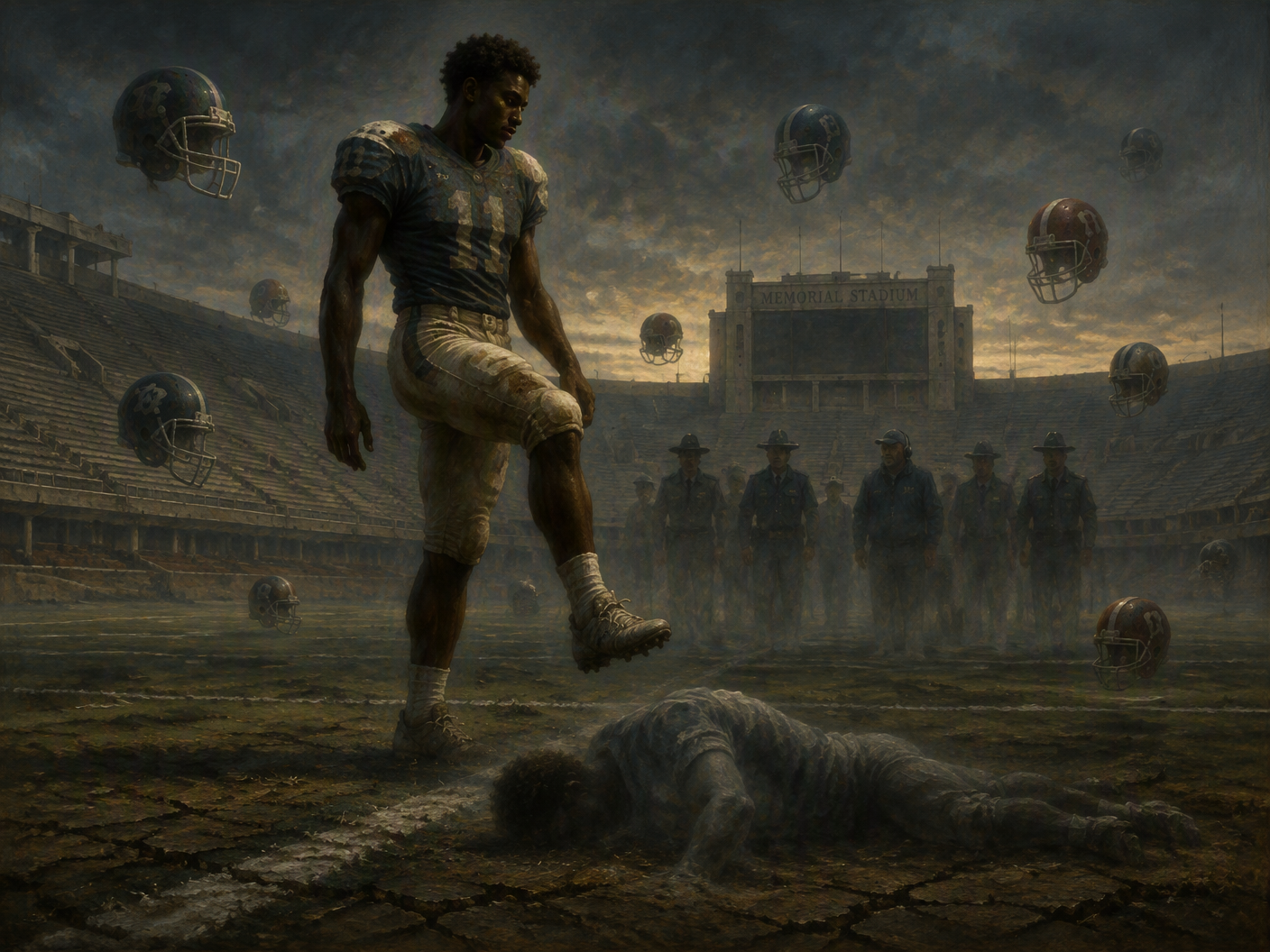
The fight began with 5:48 left at Memorial Stadium in Clemson. South Carolina had failed on fourth-and-11 when quarterback Syvelle Newton was knocked to the ground after contact to his helmet. The play had ended. The game had not. Players from Clemson and South Carolina moved into the dispute, shoving and punching as the space around Newton filled with bodies. Then both benches cleared. What had started between players became a team-wide collision on the field.
Clemson running back Yusef Kelly became the most recognizable figure in the aftermath. A photograph showed him kicking a helmetless South Carolina player in the head area while the player lay face down. The image fixed one act inside a disorderly scene and gave the brawl a face, a uniform, and a point of focus. It did not show the whole fight. It showed Kelly, one fallen player, and the instant when the rivalry had moved beyond the ordinary violence of a football play.
The game was Clemson against South Carolina on November 20, 2004, the annual meeting carrying the old pressure of a state rivalry. Tommy Bowden coached Clemson. Lou Holtz coached South Carolina, and the afternoon became his final game as the Gamecocks’ head coach. Those men stood at the edge of an argument their players had taken onto the grass. The coaches were responsible for teams. For several minutes, the teams were no longer arranged in formations or separated by the line of scrimmage.
State troopers and local law enforcement officers entered the field. Play stopped for six minutes while the officials and officers dealt with the players. The pause was not a ceremonial break and not part of the contest’s normal rhythm. Uniformed personnel had to occupy the same field where the teams had been trying to win yardage. The intervention put a hard boundary around the fight. Players had crossed it; officers restored it.
When the game resumed, Clemson finished the afternoon with a 29-7 victory. The score survived the interruption. So did the fight. The final margin could be printed in a box score, but it could not absorb the image of Kelly over the helmetless player or the sight of both benches emptying into the conflict. The game ended as a Clemson win. The disciplinary question began before the players had left the stadium.
For South Carolina, the afternoon closed one chapter and opened another. Holtz had coached his last game for the school. Newton had been knocked down at the center of the sequence that sent the benches onto the field. Around them stood teammates, opponents, officials, troopers, and local officers, all forced into the same six-minute stoppage. The incident was not a single exchange that ended when one player stood up. It spread through the rosters, and the response would spread with it.
Two days later, the conferences acted in parallel. The Atlantic Coast Conference suspended six Clemson players for one game. The Southeastern Conference suspended six South Carolina players for one game. The punishment did not belong to one sideline. Each league answered for its own team, and each team lost six players for the next contest. The numbers made the response plain: twelve players, two conferences, one-game suspensions.
Clemson athletic director Terry Don Phillips later described the brawl and the bowl-ban response in an Associated Press story, placing the episode inside the school’s institutional aftermath. His role was different from Bowden’s. Bowden had been the head coach on the field; Phillips dealt with the consequences that followed it. The distinction mattered in the days after the game, when the players’ conduct became an athletic-department problem and the conference penalties became part of Clemson’s season.
The public picture remained narrow but forceful. Newton went down after the helmet contact. Players shoved and punched. Both benches cleared. Kelly was photographed kicking a face-down, helmetless South Carolina player in the head area. Officers entered, and six minutes disappeared from the game clock before Clemson completed a 29-7 victory. Those events formed the immediate shape of the afternoon: a failed fourth down, a fallen quarterback, a fight that widened, and an official response that arrived after the score had already been decided.
On November 22, the rivalry had become a list of suspended players and empty places waiting in two locker rooms. Six Clemson players would miss one game. Six South Carolina players would miss one game. The suspension did not erase the shove, the punch, the kick, or the six-minute stoppage. It was the concrete residue left after the officers walked off the field and the teams went home: twelve players removed from the next Saturday, and one final game for Lou Holtz attached forever to the fight at Clemson.
Investigative Dossier & Evidence
Read the companion investigation notes, verified source claims, and primary documents.
Read the Companion Notes & Evidence Record →